RTL8730E_EVB
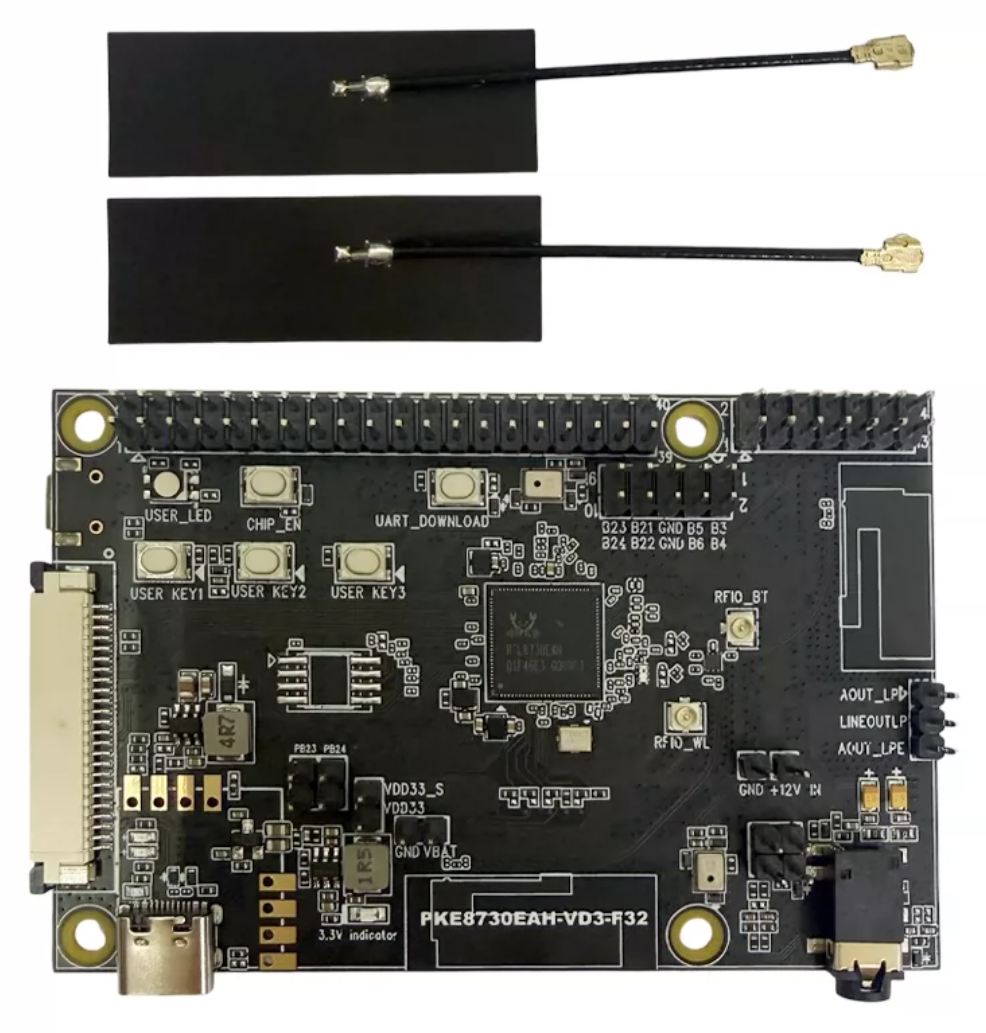
The RTL8730E EVB development board.
The RTL8730E_EVB is a Realtek RTL8730E evaluation board built around the RTL8730EH (DDR2 64 MB, 16 MB NOR flash). NuttX runs on the dual-core Arm Cortex-A32 application processor at up to 1.2 GHz as BL33 in the ATF boot chain. See the RTL8730E chip documentation for the full SoC specifications and vendor-SDK dependency.
Features
RTL8730EH: dual-core Arm Cortex-A32 up to 1.2 GHz, 64 MB DDR2, 16 MB NOR flash
Symmetric Multi-Processing (SMP) on both Cortex-A32 cores
Wi-Fi 6 (802.11ax) dual-band (2.4 / 5 GHz) station and SoftAP
Bluetooth 5 dual-mode (BR/EDR + LE)
SPI NOR flash with littlefs at
/dataLOG-UART console at 1500000 8N1
Supported in this NuttX port:
NSH shell over the LOG-UART console
SMP on both Cortex-A32 cores; tasks are dispatched across CPU0 and CPU1 by the NuttX SMP scheduler
GPIO pins exposed as
/dev/gpioNcharacter devices (input, output and interrupt), driven through the SDK fwlib ROM layerGeneral-purpose UARTs exposed as
/dev/ttySNserial devices, driven through the SDK fwlib ROM layer (the LOG-UART owns the console and/dev/ttyS0)I2C master buses exposed as
/dev/i2cNcharacter devices, driven in polling mode through the SDK fwlib register layerlittlefs persistent storage mounted at
/data(a dedicated SPI NOR flash partition), backing the Wi-Fi key-value storeWi-Fi station and SoftAP through the
wapitoolDHCP client (STA) and DHCP server (SoftAP)
/etcread-only ROMFS populated from the board’ssrc/etc/tree
Configurations
Build and flash any of these per the RTL8730E build instructions.
$ ./tools/configure.sh rtl8730e_evb:<config-name>
nsh
Networking-enabled NSH with SMP, littlefs at /data, and the wapi
Wi-Fi tool. The console is the LOG-UART at 1500000 8N1.
gpio
Minimal NSH with the GPIO driver and the gpio example enabled (no Wi-Fi).
The board registers three pins from its pin table (see
boards/arm/rtl8730e/rtl8730e_evb/src/rtl8730e_gpio.c): an output at
/dev/gpio0, an input at /dev/gpio1 and an interrupt pin at
/dev/gpio2. Edit that table to match a board’s wiring. Exercise them
with the example:
nsh> gpio -o 1 /dev/gpio0     # drive the output high
nsh> gpio /dev/gpio1          # read the input
nsh> gpio -w 1 /dev/gpio2     # wait for a falling-edge interrupt
Pins are encoded with the AMEBA_PA() / AMEBA_PB() helpers from
arch/arm/src/common/ameba/ameba_gpio.h (port A/B, pin 0-31), matching the
Ameba SDK PinName layout.
uart
Minimal NSH with the general-purpose UART driver and the serialrx /
serialblaster examples enabled (no Wi-Fi). The LOG-UART owns the console
and /dev/ttyS0, so the board registers UART0-2 from its table (see
boards/arm/rtl8730e/rtl8730e_evb/src/rtl8730e_uart.c) as /dev/ttyS1-3
at 115200 8N1. Edit that table – controller, TX/RX pads and baud – to match a
board’s wiring. The TX/RX pads use the same AMEBA_PA() / AMEBA_PB()
encoding as the GPIO table; the driver muxes them to the UART function and
pulls RX high through the SDK ROM. Exercise a port with the examples (loop TX
back to RX, or wire it to a host serial adapter):
nsh> serialblaster /dev/ttyS1 26   # stream a test pattern out /dev/ttyS1
nsh> serialrx      /dev/ttyS1 26   # receive and dump bytes from /dev/ttyS1
The line format can be changed at runtime through tcsetattr() (the config
enables CONFIG_SERIAL_TERMIOS). UART3 is reserved for Bluetooth and is not
exposed by the driver.
i2c
Minimal NSH with the I2C master driver and the i2ctool (system/i2c)
enabled (no Wi-Fi). The board registers its I2C controllers from a table (see
boards/arm/rtl8730e/rtl8730e_evb/src/rtl8730e_i2c.c): I2C0 at
/dev/i2c0 on PA10/PA9, I2C1 at /dev/i2c1 on PA4/PA3 and I2C2 at
/dev/i2c2 on PB11/PB10 (SCL/SDA). Edit that table – controller and
SCL/SDA pads – to match a board’s wiring; the pads use the same
AMEBA_PA() / AMEBA_PB() encoding as the GPIO table and are muxed to
the I2C function through the SDK ROM. Unlike the GPIO and UART crossbars, a
pad reaches exactly one I2C controller, and pads the audio codec drives
cannot be used. The I2C bus is open-drain, so fit external pull-ups on
SCL/SDA. Probe a bus with the tool:
nsh> i2c dev -b 0 0x03 0x77 # scan /dev/i2c0 for devices
Wi-Fi
Station (connect to an AP):
nsh> wapi mode  wlan0 2
nsh> wapi psk   wlan0 <password> 3
nsh> wapi essid wlan0 <ssid> 1
nsh> renew wlan0
SoftAP (become an access point, with a DHCP server for clients):
nsh> wapi mode   wlan0 3
nsh> wapi psk    wlan0 <password> 3
nsh> wapi essid  wlan0 <ssid> 1
nsh> dhcpd_start wlan0
Stop the SoftAP with wapi essid wlan0 <ssid> 0.
License Exceptions
This board depends on Realtek vendor code that is not part of NuttX and is subject to its own license:
The prebuilt Wi-Fi / Bluetooth firmware image and the Realtek
ameba-rtosSDK libraries/headers linked into the image. See the SDK’s own license; the SDK is auto-fetched and is not redistributed in the NuttX tree.The prebuilt ATF BL2 and BL32 binaries under
prebuilt/are provided by Realtek and are subject to the Realtek binary license included in the SDK.